Discover our capabilities
TRAILER LOADING AND UNLOADING
INVENTORY CONTROL
ORDER PROCESSING
ORDER PICKING
PICK AND PACK
EDI DOCUMENT SENDING
BOL/PACKING SLIP CREATION
CUSTOMER ROUTING
Selling into Target and Walmart is a different discipline from selling online. Every pallet has a routing guide behind it, every purchase order has a delivery window, and every mislabeled case is a chargeback waiting to happen. Our retail distribution services move full case and above straight from our warehouse to your retail partners, with the accuracy and consistency of big box vendor compliance demands.
We have been doing this for 34 years out of two Wisconsin facilities in Kenosha and Pleasant Prairie, primarily for personal care, cosmetics, and wellness brands.
What Direct to Retailer Shipping Requires
Cutting out the middle man sounds simple until you read what each account expects on paper. Retailers do not just want product on the dock. They want product that arrives inside its window, labeled to their spec, on pallets built to their standard, with an electronic notice sent before the truck shows up.
That is the work we take off your plate:
- Full case and above picking against retailer order quantities rather than consumer order quantities.
- Case labels, retailer-specific labels, and new case UPCs created and applied where a program calls for them.
- EDI transmission and advance ship notices handled by an EDI-certified team.
- Delivery appointments booked directly in each retailer’s portal, inbound and outbound.
- A dedicated account manager and dedicated pickers who know your SKUs and your accounts.
The Accounts We Ship Into
Our clients sell into drug, retail, mass, and club. Day to day, that means:
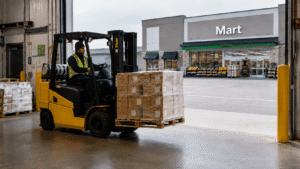
- Target and Walmart, where on time in full scoring and strict labeling rules make small errors expensive at scale.
- Costco and Sam’s Club, where club pack presentation and pallet display requirements drive how the load is built.
- Walgreens and CVS, where tight count accuracy and labeling matter as much as the delivery window.
When those same programs also need smaller order work, our pick and pack operation runs from the same building and the same inventory.
Fewer Chargebacks and Stronger Scorecards
Most vendor compliance deductions are not pricing disputes. They are preventable warehouse errors: a wrong label, a missing packing slip, a pallet that does not meet grade-A standards, an ASN that arrives after the truck does. Individually the fines look minor. Cumulatively they eat margin, and they follow you into your next line review.
Those fines land on the brand, not the warehouse. That is why we work backwards from the scorecard. Because one team controls the picking, the labeling, the pallet build, and the appointment, there is no gap between vendors where an error can quietly sit until the retailer finds it. And if a deduction does come back to us, we investigate it, when the fault is ours, we credit you for the fine.
Your retailers already published their rules. Get in touch to walk through your accounts, your volume, and what it takes to ship clean into every one of them.
We don’t miss.
Inside Our Retail Distribution Warehouse
Our 3PL fulfillment center is built around case and pallet movement, not single item picking bolted onto a small parcel operation. Across roughly 400,000 square feet in Kenosha and Pleasant Prairie, we are FDA-registered, ASI-certified, and licensed by the Wisconsin Department of Agriculture.
- Value added work on site. Display builds, club packs, kitting, and co-packing happen where your inventory already sits, so product never moves twice.
- Scheduling in both directions. We book inbound and outbound appointments through retailer portals, keeping receiving and shipping from bottlenecking each other.
- Both channels under one roof. Retail, B2B fulfillment, and ecommerce run from the same operation, so you are not splitting stock across providers.
Frequently Asked Questions
What is retail distribution?
Retail distribution is the process of moving finished goods from a manufacturer or brand into retail stores, usually in full case or pallet quantities. It covers storage, order picking, compliance labeling, pallet building, appointment scheduling, and the electronic documents retailers require. Unlike ecommerce fulfillment, the buyer is a retail chain with published rules, and meeting those rules is part of the service.
How is a retail distribution center different from an ecommerce fulfillment center?
A retail distribution center is optimized for volume and consistency: full cases, built pallets, scheduled dock appointments, and retailer specific labeling. An ecommerce fulfillment center is optimized for speed on single item orders going to consumers. The equipment, the pick paths, and the compliance requirements are all different, which is why brands running both channels benefit from a partner that operates them side by side.
What is an ASN in shipping?
An ASN, or advance ship notice, is an electronic message sent to the retailer before a shipment arrives, listing exactly what is on the truck down to carton and SKU level. It lets the receiving distribution center check freight in by scanning instead of counting. A late or inaccurate ASN is one of the most common causes of retail chargebacks.
What causes vendor compliance chargebacks?
Most chargebacks come from small, preventable errors rather than late trucks: incorrect or missing labels, a packing slip left off a pallet, pallets that do not meet the retailer’s standard, counts that do not match the ASN, or a missed delivery window. Because requirements vary by account and change over time, the practical defense is having one team that knows each retailer’s current rules controlling the whole sequence rather than several vendors each handling a piece of it.
How much do retail distribution services cost?
Pricing usually combines storage, charged by pallet position or square footage, with handling fees per order, per case, or per pallet, plus freight. The total depends on your volume, how many retail accounts you ship to, and whether the program needs extras such as co-packing or display assembly. The clearest way to get an accurate number is to walk through your actual account list and volume with a distribution team directly.
What should I look for in a retail distribution partner?
Look for account specific compliance knowledge, not general warehousing experience. Ask which retailers the provider already ships to, whether it books appointments directly in retailer portals, how it handles EDI, and who you speak to when a shipment is at risk. A capable retail distribution company should be able to describe your retailer’s requirements without looking them up.
You benefit from our experience in delivering effective solutions to the complex global supply chains of some of the world’s biggest corporations.
You benefit from every innovation, whether it involves a simple extension to our Air and Ocean Freight products, whether it means a development in warehousing.
All of which explains why you’ll find the team of outstanding support at TransCargo ready to apply their passion for solutions in support of your business.